

CowboyBootsDB reference collection
Sturgeon
Reference photos
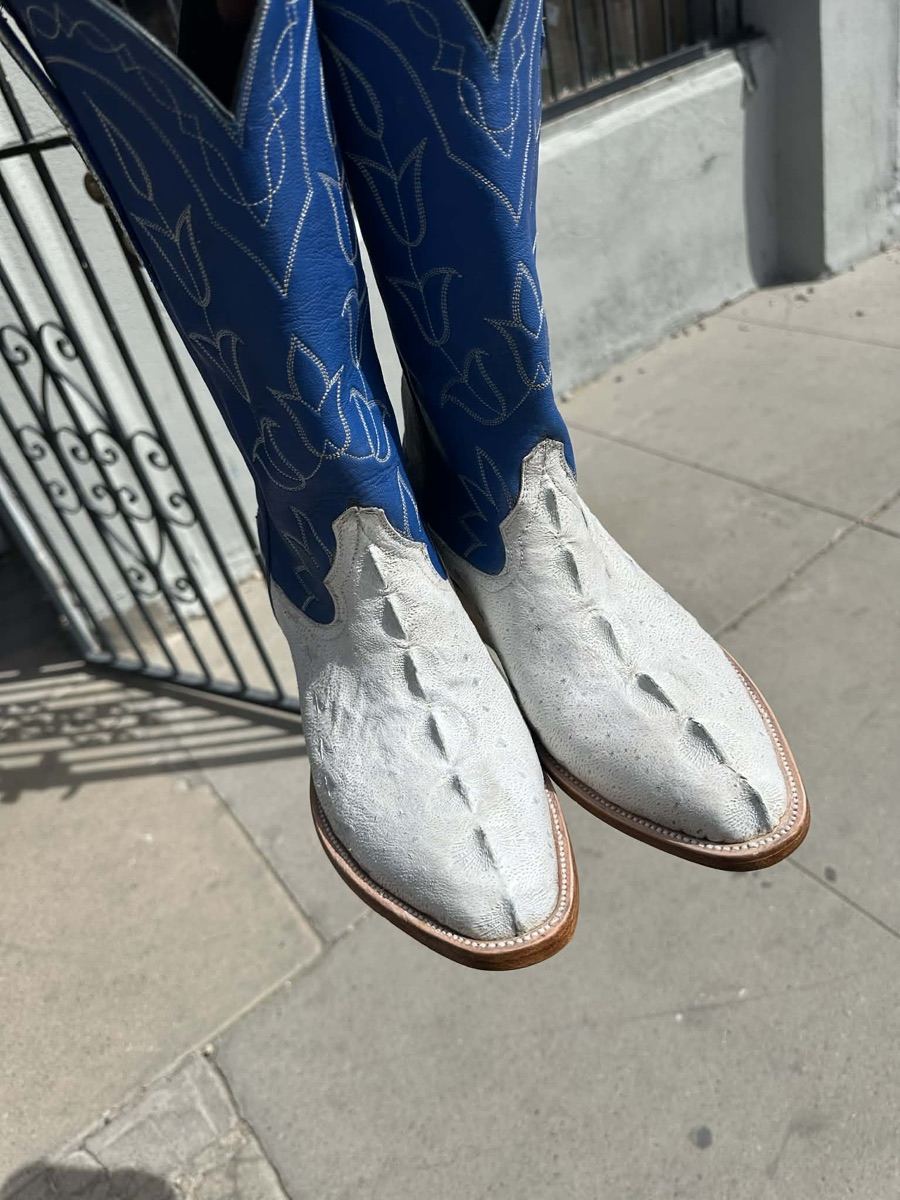
Pattern
A fish leather defined by directional rows of raised bony scutes. More armored and structured than eel or salmon, with a clear line running down the vamp.
Also known as
Sturgeon · Sturgeon Fish
Scientific name
Acipenseridae spp.
Family / genus
Acipenseridae
Collector notes
A fish leather that collectors learn through the armor-like line of scutes and the directional pattern they create down the vamp.
Quick identification checks
- Look for the longitudinal rows of hard bony scutes that make sturgeon read unlike eel or salmon.
- The pattern should flow directionally and not look like a random reptile tile.
- Good examples show the scute rows clearly without over-finishing them into a flat shine.
Check in hand
- Sturgeon should feel structured for a fish leather, with noticeable relief where the scute rows sit.
- The leather between rows should still feel flexible instead of brittle.
- Watch for finish separation around the raised scute line on older pairs.
Common mix-ups
- Eel: Eel is long and linear but much smoother, without the raised armor-like scute rows of sturgeon.
- Pirarucu: Pirarucu reads with much larger plated cells, while sturgeon keeps narrower directional rows.
- Embossed Fish Print: Prints often miss the true relief and directionality of the real scute pattern.
Buyer notes
- The best sturgeon pairs show a clean, readable line of scutes on both vamps.
- Ask for vamp-focused photos because side views do not teach the pattern nearly as well.
- Condition lightly and avoid heavy product buildup on the raised rows.
Maker history
A niche exotic more often seen in specialty or boutique production than in the core catalogs of the largest western makers.
Era notes
A collector-market material rather than a mainstream western staple, usually surfacing in specialty pairs and more recent exotic experimentation.
Care notes
Condition lightly, keep heavy product off the raised scute rows, and inspect the relief line for finish separation on older pairs.
Watch for
- Eel or pirarucu confusion
- Flat embossed fish print sold as sturgeon
- Finish separation along the scute rows
Read the original CowboyBootsDB article
Sturgeon leather is one of the more structurally distinct fish leathers in the boot world, and what makes it immediately recognizable is the directional row of raised scutes running through the hide. Those bony, armor-like bumps are not a stylistic choice — they are an anatomical feature of the fish itself, and they give sturgeon leather a three-dimensional quality that separates it sharply from other fish-skin exotics. On a well-executed pair, the scute rows should be clearly visible on the vamp, reading as an honest structural feature rather than an embossed texture.
Sturgeon pairs should be photographed well and close. The scute structure is the whole point, and listings that only show wide or low-resolution vamp shots are not giving you the information you need to evaluate whether the leather is genuine or the placement is good. If the relief of the scute rows is not clearly legible in the photos, the listing has not done its job.
History
Sturgeon have been harvested for caviar and meat across Russia, Eastern Europe, and North America for centuries, and the hides were historically processed as a byproduct of the fishery rather than the primary product. The fish was valuable for what came out of it, and the skin was available as a consequence. Russian and Eastern European tanneries developed sturgeon leather for luxury goods in the 19th and early 20th centuries, and the distinctive scute rows were recognized early as a visual feature worth showcasing rather than smoothing away. The structural character of the hide — the thing that made it different from generic fish leather — was the commercial argument.
In the American western boot market, sturgeon leather appeared primarily through boutique and custom channels rather than mainstream production. The limited supply of quality hides and the specialized tanning process required to preserve the scute structure kept it from scaling the way ostrich or python had. That restricted distribution gave sturgeon a quiet rarity that differs from the prestige-driven scarcity of crocodilian — it is a material that never reached the volume to become a standard offering, not one that was priced out of reach.
The sourcing picture has changed significantly in recent decades. Beluga, osetra, and other Caspian Sea sturgeon species were historically the most prized for leather, but most of these are now critically endangered and subject to strict CITES protection. Commercial boot leather today typically comes from farmed North American white sturgeon (Acipenser transmontanus) or from South American and Asian farmed species. Well-documented farmed sturgeon leather is available and represents the responsible sourcing choice for new production — the shift to farmed stock parallels the broader exotic leather industry's move away from wild-harvested species.
What Collectors Look For
The scute rows are the primary evaluation feature, and the first question is whether they read convincingly in photos and in hand. Strong pairs show readable scute relief that casts real shadows under angled light — bumps that look structural rather than decorative. The rows should run with natural directional consistency across the vamp, and the best pairs keep left and right sides matched so the overall layout reads as balanced rather than chaotic.
Finish quality matters too. Heavy gloss can obscure the scute relief and make a good sturgeon pair look like a generic fish-leather print. The finish should enhance the structural character of the leather rather than bury it. If the vamp looks too flat or too glossy under close inspection, question whether the finish is working for the material or against it.
How to Identify
The scute rows are the fastest and most reliable identification feature on sturgeon leather. They run directionally through the hide and create a textured pattern that is unlike any other common fish-leather or reptile-leather. The scutes themselves are raised, hard, and rounded — they have a real three-dimensional presence that you can feel in hand and see clearly in a well-lit photo. No other mainstream boot leather has quite this combination of directional structure and bony relief.
The closest confusion points are eel, which can read directionally but lacks the raised scute structure, and embossed prints attempting a fish-leather look. Eel has a more uniform, tube-like skin structure without the individual bumps of sturgeon. Prints trying to replicate sturgeon usually get the general directional character right but fail on the actual three-dimensional presence of the scutes — a stamped imitation will look flatter and read less convincingly under angled light than real sturgeon relief.
Sturgeon
- Raised, bony scute rows with real three-dimensional structure
- Scutes cast distinct shadows under angled light
- Hard, rounded bumps you can feel clearly in hand
- Directional pattern that reads as structural, not decorative
Eel
- Smooth, tube-like skin structure without raised bumps
- Directional grain but no scute or bony relief
- Flat texture even under close angled inspection
- Often has a more uniform, almost plastic-like sheen
Real vs. Print
Genuine sturgeon leather has raised scutes with real three-dimensional structure. The scute bumps are not a printed pattern or an embossed surface — they are hard, organic, and cast genuine shadows under raking light. This makes sturgeon one of the easier exotics to authenticate at close range, because no embossed print can fully replicate the actual structural presence of a raised scute row. The depth and the hardness of the bumps are both diagnostic.
A useful check: examine the scute rows under angled light or from a low viewing angle across the vamp. Real scutes should appear clearly dimensional, with hard edges that create distinct light-and-shadow contrast. An embossed print attempting the same look will appear flatter and the bumps will have softer, less convincing edges. Finish separation at the top of the scute bumps — where the finish tries to coat over a raised feature — is also a warning sign that the structure is real but the finish has been applied incorrectly.
Care Tips
Sturgeon leather needs careful maintenance to protect both the underlying hide and the raised scute structure. Condition every 90 days with a fish-leather-appropriate conditioner, applied lightly with a soft cloth. Pay particular attention to the areas around the scute rows, where the hide can dry and crack at the base of the bumps if the leather is neglected. Avoid heavy polish or thick wax that can build up at the scute edges and obscure the texture over time. Keep moisture exposure low, dry wet boots slowly at room temperature, and store with shoe trees to maintain vamp shape. Inspect the scute bases regularly for any early cracking, which signals the leather needs conditioning before the damage progresses.